Akhmim Mummy Studies Consortium

Ancient Egypt Coming to Life through CT-based Forensic Studies

NAVIGATE:

Akhmim Mummy Studies Consortium

The Akhmim Mummy Studies Consortium (AMSC) directs  CT  (computed tomography) scans on Egyptian mummies and archives the information for research purposes. The Consortium has facilitated mummy research and museum exhibition projects throughout the United States. It is the foremost mummy imagery creator in North America.  Its findings have provided Egyptologists, other mummy researchers and general audiences with a steady stream of new data to enliven the discussion of ancient Egyptian culture, mummification ritual and related topics (See the Akhmim Mummy Project Update for more information).

Please Note: The Consortium performs its research to advance its own mission, and those of its museum partners and other institutional collaborators. Its mummy image material is copyrighted for use in its own projects and investigations. It is not affiliated with other research endeavors or mummy data acquisition projects. The Consortium does not allow the posting of its research imagery in any publication, website or database without its explicit agreement and consent.


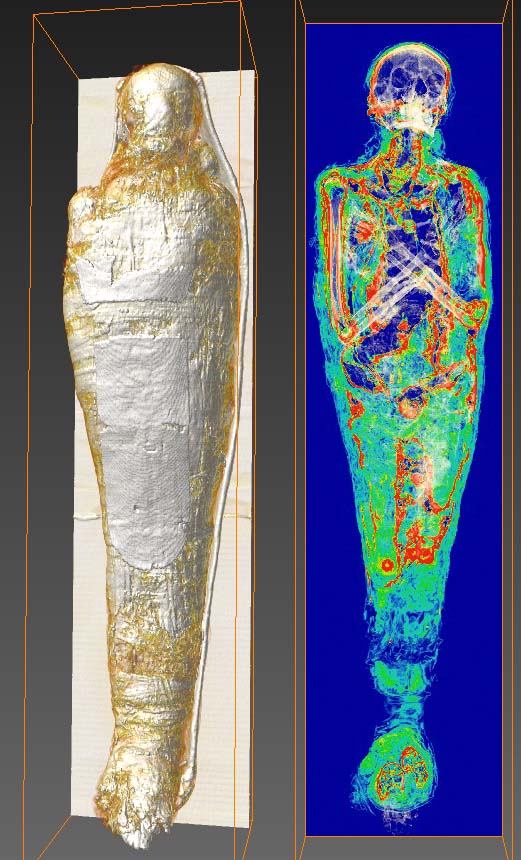
3D Reformat of Ta-irty's mummy.

Ta-irty, whose mummy was scanned in

2003 in collaboration with the College of

Wooster (Ohio) is forensically interesting.

This view shows her arms carefully crossed

at the breast (right arm over left), an indicator

of Osirian status among priests and other

well-to-do persons at Akhmim. The mummy

dates to the 3rd century BC, a time when

the crossing of arms was no longer a special

attribute of royal funerary preparation.

© 2003 Akhmim Mummy Studies Consortium.

All Rights Reserved.


THE AKHMIM MUMMY STUDIES CONSORTIUM

Mission

The mission of the Akhmim Mummy Studies Consortium (AMSCResearch LLC) is to advance knowledge of ancient Egyptian mummies from Akhmim and other important regions. AMSCResearch uses its findings to improve understanding of the processes and rituals of Egyptian mummification in general.
AMSCResearch promotes the use of CT as a tool for bioanthropological analysis of the population dispersed from the site, and supports large scale forensic reconstruction of Egypt's ancient inhabitants in order to improve understanding of the diversity of various regional populations in the Nile valley.

The Consortium was established in 2004 to perform research on ancient Egyptian mummies, particularly those associated with the city of Akhmim. In 2007, it began to analyze mummies from other ancient Egyptian sites. These mummies provide important comparative information by which the evolution of mummification methods can be assessed. CT scans of mummies from the sites of Thebes (Luxor) and Tebtunis (Fayum region of northern Upper Egypt) are now part of the Consortium's data sets.

The Consortium's Community of Portraits TM

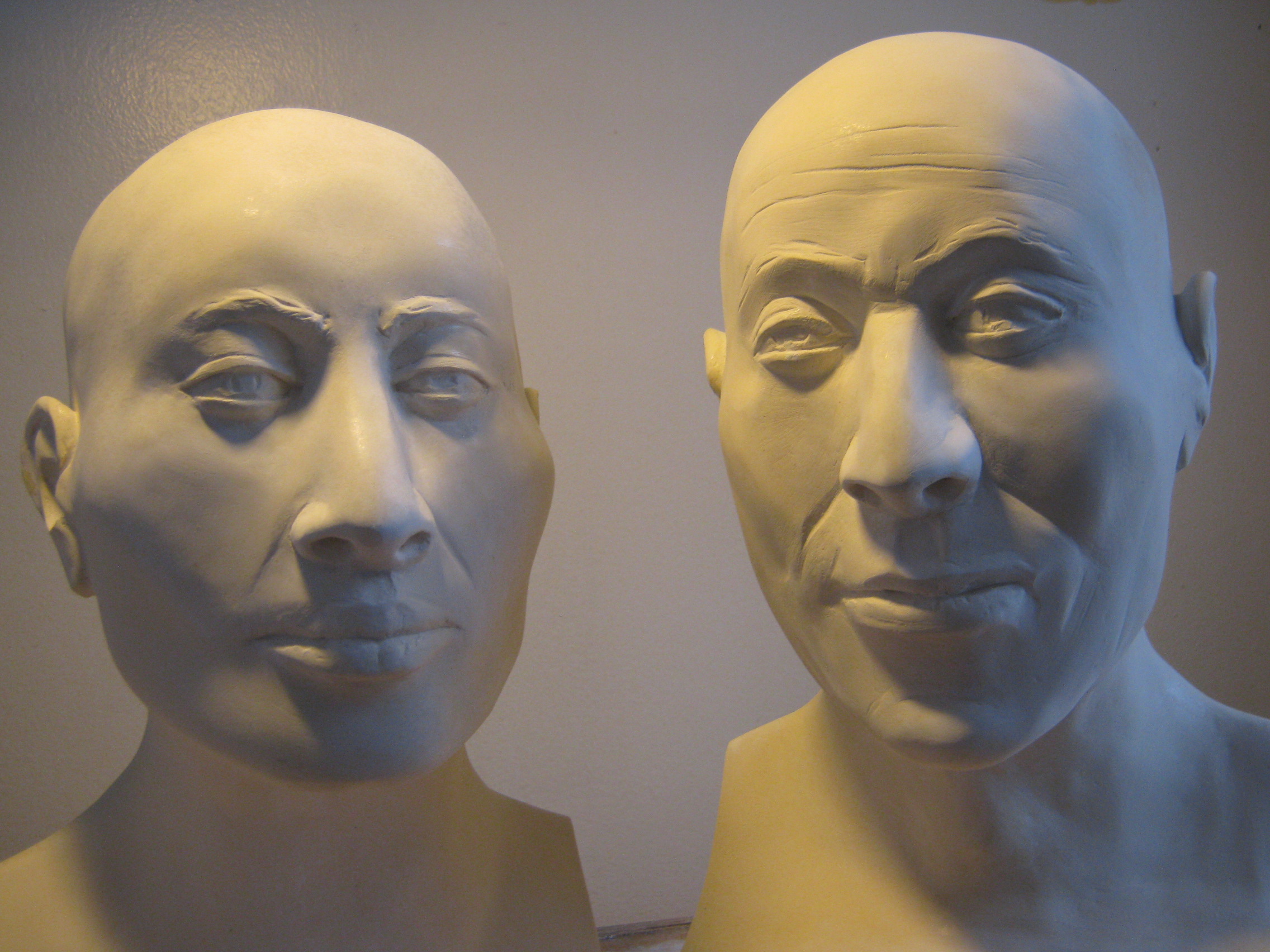
An important aspect of our work is the creation of a true "Community of Portraits" of ancient Egyptian people using modern methods of forensic facial reconstruction and CT-based skeletal modelling. The Community of Portraits TM serves the needs of educational and museum facilities insofar as it helps to portray the ancient Egyptian population for purposes of discussing issues of health, lifestyle, ethnicity and a variety of other scientific topics. AMSCResearch  believes that forensic facial reconstruction is a research method which can provide important clues to the ethnicity of the population associated with the city of Akhmim and can be used to explore the ethnic diversity of ancient Egypt more generally.

Exhibition Content Development Services

AMSCResearch regularly assists institutions with Egyptological collections to improve exhibition content and organization. For institutions holding mummies from Akhmim, AMSCResearch can greatly expedite the work necessary to analyze mummy CT scans and produce forensic reconstructions of mummified individual for educational purposes. For most mummies, the process of forensic reconstruction is an effective means of restoring "person-hood" and dignity within museum environments. This is important work having clear implications with regard to the visual diversity of the ancient Akhmimic population. AMSCResearch will gladly work with mummy-owning institutions to evaluate mummy provenience and if possible to assess genealogical position and family relationships. AMSCResearch maintains data sets which can help in this regard. Furthermore, AMSCResearch seeks to facilitate mummy CT reconnaissances on Egyptian mummies, and to provide mummy-owning institutions the means to formulate forensic reconstructions of ancient persons. AMSCResearch invites mummy-owning museums wishing to develop forensic portraits to partner with it and help to rediscover this important ancient community.

Disclaimer

The AMSCResearch promotes only careful, non-injurious investigation of Egyptian mummies. Although AMSCResearch is involved in making forensic exhibits, it is not a "cadaver art" project, nor does it perform its work invasively with respect to the mummified population of ancient Egypt. AMSCResearch does not condone the use of plastinated bodies for exhibition purposes, nor does it believe that such endeavors represent a positive form of science education.


Outskirts of Akhmim. Consortium activities have included survey work on-site to help document the locations of Akhmim's ancient tombs. Americans became aware of mummies at the site in April of 1884. It is possible that Egyptian authorities begain selling Akhmimic mummies to raise funds for their war effort against fundamentalists in Sudan. AMSCResearch regularly facilitates study of mummies brought to the United States at that early period. © 2009 Akhmim Mummy Studies Consortium. All Rights Reserved.

Inquiries on the "Community of Portraits"

Website Last Updated: 1 May 2009

© 2009 Akhmim Mummy Studies Consortium

All Rights Reserved.

AKHMIM MUMMY STUDIES CONSORTIUM

P.O. Box 84, Harrisburg, PA 17108-0084 USA

Please send all inquiries to director@amscresearch.com

Mummy Database