|
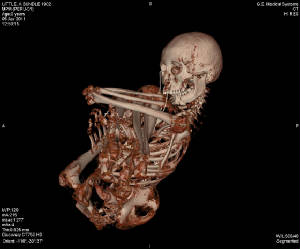
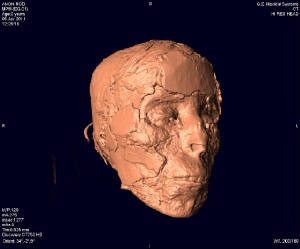
The Akhmim Mummy Studies Consortium participated in mummy CT scans performed at
GE Healthcare, Waukesha, Wisconsin on 5 April 2011, using GE’s latest generation scanner and software.
The work was performed in collaboration with the Milwaukee Public Museum and was directed by Carter Lupton
MPM’s Curator of Anthropology and History. The scanning was performed on (1) the Ptolemaic Mummy of Padi-heru-pa-khered
(stolist priest of Min at Akhmim, MPM 10265), (2) the mummified head of the Akhmimic embalmer Djedhor,
son of Pediamun (Saite Period, 664-525 BC, MPM 10264), (3) the mummified head of another Egyptian mummy of undetermined date
(MPM N2121), and (4) a Peruvian bundled mummy dated provisionally to AD 1300-1500 (MPM E2835). The Peruvian mummy entered
the collections of the Milwaukee Public Museum in 1902. The scans of Padi-heru-pa-khered and Djedhor are of a higher resolution than any
previously attempted and are already proving to be of great value in the on-going analytical work on these Akhmim mummies.
The scan of the Egyptian head (MPM N2121) is the first attempted on it, and will be helpful in the Consortium’s comparative
study of Egyptian mummification, and in its study of the composition of embalming resin. In-depth analysis of the
Peruvian mummy has also begun, and the AMSC team is studying a group of fractures of the right humerus, right scapula and
multiple fractures of the mandible.
|